

Care and structure in contact
Moon-Saturn brings emotional need and structure into dialogue. Useful reading does not decide who cares or who cools: it asks what agreements, times and limits make the difference habitable.
Observe if responsibility becomes support or weight, and if asking for care is allowed for both people. The contact is not interpreted in isolation: the sign, the house, the orb and the rest of each chart change the scene it can describe.
Synastry: Moon Saturn is an astrological reading entry focused on the comparison of two charts with consent, traceable data, and attention to real experience. The astronomical position or relationship is calculated; the meaning comes from an interpretive tradition; The experience must be contrasted in concrete life.
From a technical approach, it is advisable to start with what can be verified: birth data, zodiac used, astrological house system when applicable, positions and orbs. A provisional interpretation is then formulated. Finally, scenes that support it, exceptions that limit it and alternative explanations are sought. If the birth date is uncertain, that uncertainty is part of the result and should not be filled in with the preferred description.
A constructive approach is to form ideas about the relationship that both people can review. The common risk is predicting its fate or attributing intentions. These contrasting possibilities help you ask what happens, in which context, how often and with how much room for choice.

A quick map to guide the reading
| Layer | What is observed | Useful question |
|---|---|---|
| Technical basis | The data, its source and margin of error | Can I verify the placement or relationship? |
| Symbolic function | comparing two charts with consent, traceable data and attention to real experience | What process does it help name? |
| Resource | forming ideas about the relationship that both people can review | When is it available and useful? |
| Tension | predicting a relationship’s fate or attributing intentions | What increases friction? |
| Context | Other placements, relationships and circumstances | What information changes the first reading? |
The table is not a list of traits. Each row has a different purpose. If an observation mixes calculation, interpretation and personal judgment, separate them again. This small discipline improves clarity and lets another person understand where a conclusion comes from, even if they do not share the astrological framework.
Reading a symbol without turning it into a label
First, phrase the idea using verbs. Instead of saying someone “is” a certain way, describe what they do, when they do it and the outcome. Broad adjectives feel recognizable because they fit many situations; behavior in context is more precise. Record an exception too, because it reveals conditions the label leaves out.
Second, look for proportion. A resource can become a tension when used without a pause, without information or outside the setting where it helps. Persistence can become rigidity; openness, distraction; intensity, control. The aim is not to condemn a quality, but to recognize when it needs a complementary skill.
The third step is to include agency. A chart does not require you to repeat an answer. It can be used to identify a pattern, try another behavior and review the effect. Ask what part depends on a decision, what part corresponds to material conditions, and what part requires conversation with other people. Astrology loses usefulness if it replaces the conversation, consent or professional resources that a situation needs; the symbol can open a question, not decide for two people.
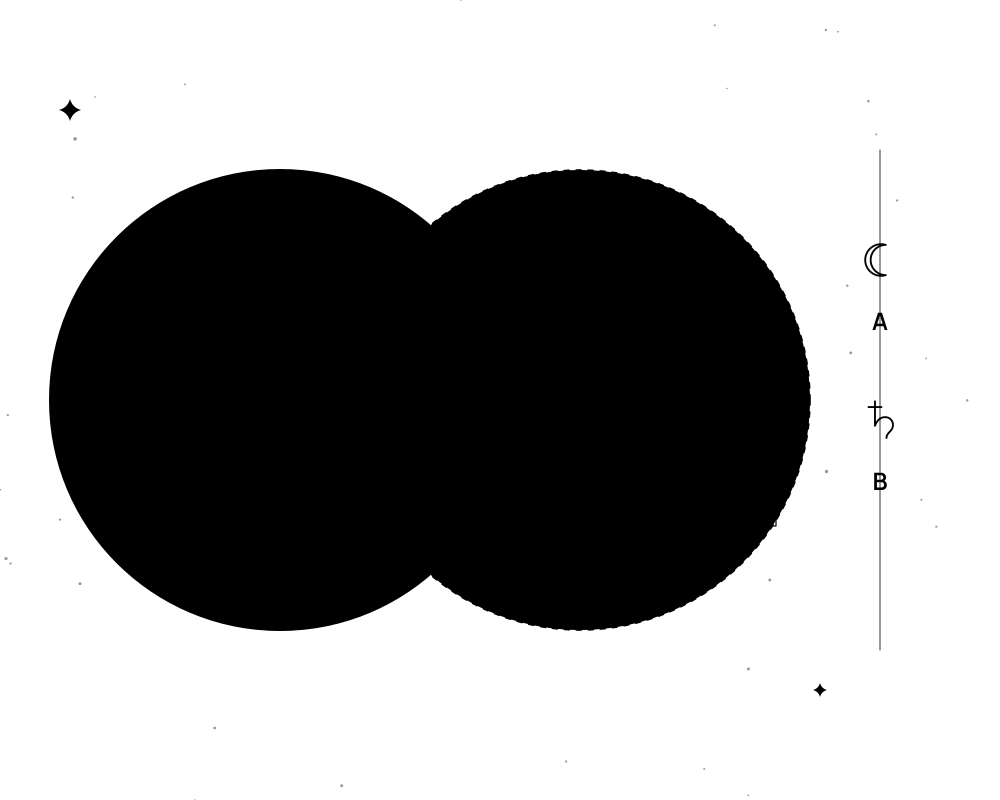
Factors that shape the interpretation
An isolated synastry reading: Moon–Saturn is always incomplete. Identify what function each planet represents, what house it falls in for each person and what aspect connects both charts. The astrological orb, time and house system change the scope; Not all data weighs equally.
Start with no more than three pieces. Define each in one sentence, explain why it matters to the question and state what data could contradict the synthesis. Add a fourth factor only if it meaningfully changes the reading. This reduces the risk of retrospectively choosing symbols that confirm an existing conclusion.
Timescale matters too. A natal placement describes a chart calculated for birth; a transit compares it with another date; a progression or return uses another procedure. Mixing techniques without naming them makes an explanation seem more precise than it is. Record the method, date and source so the analysis can be repeated.
Possible resources in everyday life
The central resource of synastry: Moon–Saturn is tested in a reversible scene: choose an agreement related to agreeing what support is possible and what responsibility remains your own, define what response you will observe and review it with the other person. Experience can confirm, qualify or discard the hypothesis.
In relationships, a good reading does not replace direct questions. It helps prepare language: “This is what I need,” “This is what I can offer,” “This is the boundary I want to agree on.” It does not authorize assumptions about desire, faithfulness, inevitable compatibility or hidden intentions. When someone corrects the interpretation, their account takes priority over an inference from their chart.
At work or in study, avoid turning astrological categories into selection criteria. You can use them privately as reflection prompts, but not as measures of competence, reliability or potential. Assess performance using relevant evidence, fair conditions and explicit goals. A symbol can open a question; it cannot replace a responsible assessment.
Tensions, shadows and self-regulation
For synastry: moon saturn, a reading risk is predicting the fate of a relationship or attributing intentions. Name it as possibility, not destiny. Ask what early signal allows you to recognize it, what need you are trying to solve, and what alternative response preserves what is valuable without repeating the cost. This formulation avoids moralizing the symbol and turns it into a self-regulation hypothesis.
An intense experience does not prove astrology caused it. Coincidence, selective memory, expectations and context can affect recognition. A dated record helps compare what was anticipated with what happened. Include matches, disagreements and ambiguous cases; discarding only what does not fit prevents learning from the method.
If an interpretation creates fear, urgency, dependence or isolation, stop the reading. No natal factor justifies harm, control or abandoning professional care. For health, safety, financial or legal decisions, use appropriate sources and specialists. Symbolic language can support reflection, but never replace specialized evidence.
A seven-step method
- Write the specific question without including your desired answer.
- Record the date, time, place, source and any uncertainty in the data.
- Define synastry: moon saturn in terms of function, not destiny.
- Describe a resource, a tension and a self-regulation skill.
- Add two contextual factors and explain why they matter.
- Find one example supporting the hypothesis and another contradicting it.
- Choose a reversible action and set a date to review the outcome.
This procedure makes the path to a conclusion visible. If two readers reach different suggestions, they can compare definitions, data and priorities instead of competing for authority. Disagreement is not resolved by piling on claims: return to the calculation, method and reported experience.
Repeat with a different question. If you always get the same answer, the definitions are probably too broad. If every detail completely changes the conclusion, the factors may need clearer priorities. Aim for a synthesis specific enough to guide observation and open enough to accept new information.
Common mistakes
The first mistake is confusing recognition with verification. A phrase can feel accurate while remaining broad. Ask for examples, frequency and circumstances. The second is isolating one factor and attributing an entire story to it. The third is reading another person’s chart without consent or contradicting what they report about their own experience.
Another mistake is choosing the technique after seeing the result. If you change house system, orb or zodiac until you find a preferred description, record that choice and do not present it as independent confirmation. Comparing methods can help when criteria are set beforehand and differences remain visible.
Seeking absolute compatibility is common too. Relationships depend on communication, safety, values, circumstances and agreements, beyond any symbolic reading. Consistent behavior and consent provide more direct information than an astrological label.
Questions to explore further
- Which part of synastry: moon saturn corresponds to a calculated data and which to an interpretation?
- In which specific situation can both people review an idea about their relationship?
- Which conditions increase the risk of predicting a relationship’s fate or attributing intentions?
- Which chart factor qualifies or contradicts the first synthesis?
- What would someone close to you say about this observation?
- What small action can test the hypothesis without a major risk?
Answer with dates and examples, rather than impressions alone. Keep contradictions: they may point to another context, an imprecise definition or an interpretation that needs review. Reflective practice does not try to make everything fit; it distinguishes what brings clarity from what should be discarded.
Frequently asked questions
Do I need my exact birth time?
It depends on the factor. Houses and angles need a sufficiently precise time. Some placements change slowly; others, such as the Moon, may change signs during the day. Without a time, work with ranges and mark what is uncertain.
Does this interpretation predict what will happen?
No. It offers questions and hypotheses for observing patterns. It does not confirm events, other people’s decisions or outcomes in health, finances or relationships.
What if the description does not fit me?
Check the data and method first. Then review context, exceptions and other factors. You do not have to force an identification: an unhelpful interpretation can be set aside.
How can I explore further?
Return to the full chart, limit the number of factors and document your reasoning. A useful next step is a specific question, a real example and a later review that keeps both matches and disagreements.